
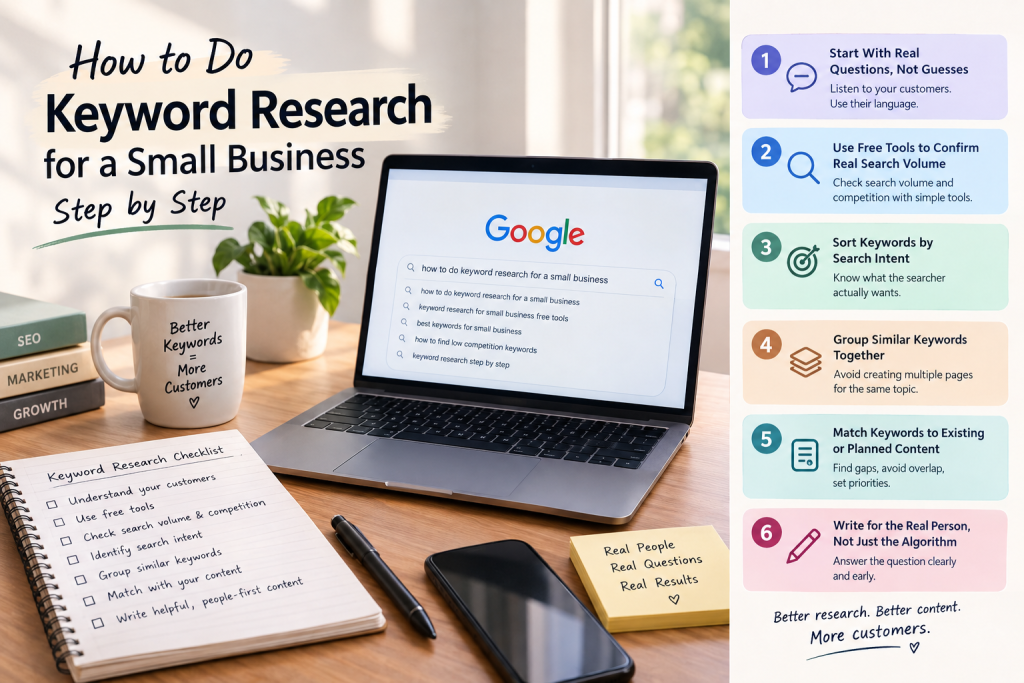
Keyword research means finding out exactly what words and phrases your potential customers type into Google when they are looking for something you offer, then using that real language to guide what you write and publish. It sounds simple, and the core idea is simple, but most small businesses either skip this step entirely or approach it backwards, guessing at keywords instead of confirming them.
Here is a practical, step by step approach you can follow even if you have never done keyword research before.
Step One: Start With Real Questions, Not Guesses
Before opening any tool, write down the actual questions your customers ask you. Think about conversations you have had, emails you have answered, or comments you get on social media. If you run a coaching business, that might be questions like “how do I know if coaching is right for me” or “what is the difference between a coach and a therapist.” These real, lived questions are almost always closer to genuine search behavior than the polished, professional language businesses tend to use to describe themselves.
This matters because a common mistake is assuming customers search using the same words you use internally. A business might call itself an “SEO strategist,” while a potential client is searching “what is an seo strategist” because they do not yet know the terminology. Our post on what an SEO strategist actually does is a good example of content built around that exact gap between industry language and customer language.
Step Two: Use Free Tools to Confirm Real Search Volume
Once you have a list of real questions and phrases, the next step is checking whether people are actually searching for them, and how often. You do not need an expensive subscription to start. Google’s own autocomplete feature, the “People also ask” boxes that appear in search results, and free tools like Google Keyword Planner or Ubersuggest can all give you a reasonable starting picture.
Pay attention to two things when you check a keyword: search volume, meaning roughly how many people search that phrase each month, and competition, meaning how difficult it might be to rank for it. A keyword with decent volume and low competition is usually a stronger early target than a high volume keyword that every large company is already fighting over.
One important lesson worth knowing before you get too deep into this: very specific phrases, like a service plus your exact city name, often carry almost no search volume at all, even in large cities. Broader terms tend to carry the real volume, with location working better as a supporting signal throughout your content rather than the exact keyword you are chasing.
Step Three: Sort Keywords by What the Searcher Actually Wants
Not every keyword means the same thing. This is called search intent, and understanding it changes what you should actually write.
Some searches are informational, meaning the person wants to learn something, like “how does local SEO work.” Some are commercial, meaning the person is comparing options, like “best SEO services for small business.” Some are transactional, meaning the person is ready to take action, like “book an SEO consultation.” Writing an educational blog post for a transactional keyword, or a hard sell page for an informational keyword, usually performs poorly because it does not match what the searcher actually wanted in that moment.
A simple way to check this yourself is to search the keyword and look at what already ranks. If the results are mostly educational articles, that is an informational keyword. If the results are mostly service pages and pricing pages, that is commercial or transactional.
Step Four: Group Similar Keywords Together
Once you have a list, you will likely notice several keywords are really just variations of the same underlying question. Group these together rather than trying to write a separate page for each slightly different phrase. This avoids one of the most common issues small business websites run into, where multiple pages compete against each other for the same search because they were written around near identical keywords without anyone noticing the overlap.
Step Five: Match Keywords to Existing or Planned Content
With your grouped list in hand, check what you already have on your website. Some keywords might already be well covered by an existing page, in which case the better move is strengthening that page rather than creating a duplicate. Others will be genuine gaps worth planning new content around.
This is also the point where you decide priority. Start with keywords that have decent search volume, reasonable competition, and a clear connection to what you actually sell. A keyword with huge volume but no real connection to your business will bring visitors who were never going to become customers anyway.
Step Six: Write for the Real Person, Not Just the Algorithm
Once you know your target keyword and the intent behind it, write content that genuinely answers the question, in plain language, as early in the piece as possible. This matters for two reasons. It helps human readers get what they came for quickly, and it also helps your content get selected as a direct answer in Google’s featured snippets or AI Overviews, and increasingly by AI tools like ChatGPT and Perplexity, all of which favor content with a clear, direct answer near the top.
If you want to see this approach applied to a related topic, our post comparing an SEO strategist and an SEO content strategist walks through exactly this kind of research and structure decision.
If keyword research feels overwhelming to do on your own, that is completely normal, and it is exactly the kind of work covered under SEO strategy services. Book a free consultation and we can map out a realistic starting list together.
A Simple Example, Start to Finish
Imagine you run a small photography business. You start by listing real questions clients ask, like “how much does a wedding photographer cost” or “what should I wear for family photos.” You check these in a free keyword tool and find that “what should I wear for family photos” actually has decent search volume and relatively low competition, while “wedding photographer pricing” has more competition but is closer to a buying decision.
You would likely plan an informational blog post around the family photo outfit question, since it is genuinely useful and low competition, and a clearer, more direct pricing or packages page around the wedding photography question, since that searcher is closer to booking. That is keyword research working the way it is supposed to, guiding real decisions rather than just producing a list.
Frequently Asked Questions
Do I need to pay for a keyword research tool to get started?
No. Free tools like Google’s autocomplete, the People also ask boxes, and free tiers of tools like Ubersuggest are enough to get meaningful direction when you are starting out. Paid tools become more useful once you are managing a larger site or a more competitive niche.
How many keywords should a small business target at once?
It is better to start with a focused list of ten to twenty well researched keywords than to try to chase a hundred at once. A smaller, well targeted list is easier to build genuinely strong content around.
How often should I redo keyword research?
Revisiting your keyword list every few months is a reasonable habit, especially as your business grows or your industry shifts. Search behavior is not static, particularly with AI search tools changing how people look for answers.
What is the biggest mistake people make with keyword research?
Choosing keywords based on what sounds impressive or professional rather than what real customers actually search. A slightly less polished phrase that matches genuine search behavior will usually outperform a technically correct term nobody actually types into Google.
Should keyword research come before or after I write content?
Always before. Writing first and hoping it happens to match search behavior is far less reliable than starting with confirmed keywords and building content around them intentionally.
Final Thoughts
Keyword research does not need to be complicated or expensive to be effective. At its core, it is about listening closely to how your real customers actually talk and search, confirming that with simple tools, and letting that real language guide what you publish. Small businesses that treat this as an ongoing habit, rather than a one time task, tend to build far stronger organic visibility over time.
If you would rather have a second set of eyes on your keyword strategy, get in touch here and we can walk through where your real opportunities are.